
By Inès Weber
Edited by Marina Yan
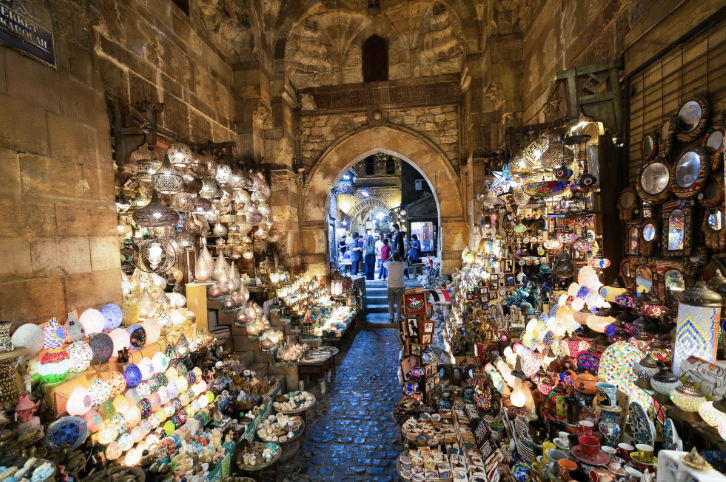
Exploring Khan El-Khalili Bazaar in Cairo, the famous Egyptian market originating in the 14th century, you will smell an array of spices, notice the handmade textiles, and hear intense bargaining from locals all around. Looking up, the historic carved stone gates frame the street elegantly. Yet at a nearby stall, you will also spot a man scrolling on an iPhone 17 Pro Max (probably orange). To him, it’s ordinary. To a visitor, it’s fascinating. Khan El-Khalili Bazaar is only one mere example of the seamless anachronism created by modern society; across Egypt, centuries-old buildings are still being used as schools, shops, and homes.
Egypt’s architectural history spans over 5,000 years, and its rulers have repeatedly molded what they inherited. The Old Kingdom experienced the first era of grand construction and laid the foundation of Egyptian architecture. The use of limestone and sandstone ensured the longevity of ancient monuments such as the Luxor Temple, built during the New Kingdom.
From 332 BC to 395 AD, Egypt underwent a Greco-Roman period. The catacombs of Kom El Shoqafa in Alexandria, built in the 1st century AD, contain a mix of Roman, Greek and Egyptian architecture. Deir el-Bahari (an unreasonably photogenic cliffside, worth a google) was built around the New Kingdom period and converted into a monastery during the late Byzantine Period. Coptic architecture sometimes transformed ancient buildings.
In the 13th century, Abu Haggag Mosque was built within the ancient Luxor Temple. The mosque dates back to the Islamic period, it is still used for worship today.
By the 20th century, modernism increased in Egypt. Egyptian architects questioned the dominant Western styles. Hassan Fathy, a pioneer in the continuation of Egyptian regional identity, revived traditional mud-brick and earth-based construction techniques. His project “New Gourna village” illustrates the revival.
After tracing the history of Egypt’s architecture, the relationship of past and present seems to be complementary. However, the relationship is straining. Egypt has a massive volume of ancient sites to preserve, so state resources are overloaded. Egypt’s major cities have been losing historical buildings due to shortages in funding and rapid urban growth. For instance, over 1,000 historical buildings in Alexandria risk losing their protected status, leaving them open for demolition, according to Legal Agenda. Developers plan to tear down historic 19th- and 20th-century villas and cultural venues for high-rise residential towers or commercial hotels. While monumental structures in Luxor such as the Luxor Temple draw much attention and international funding, minor architecture such as old residential quarters is left to be neglected. Coexistence doesn’t happen on its own. It depends on which layers are tended to.
So what does a tended layer look like? Stepping out of the bazaar and bending onto Al-Muizz Street, you notice the traditional architecture. Since 2008, Al-Muizz Street has become a pedestrian-only street which helps protect it. Bracing yourself for the 1 kilometer long walk, you notice an imposing building, the Qalawun Complex. Built between 1284 and 1285, the complex housed a hospital, school, mausoleum, and a mosque. Currently it’s a tourist attraction and offers a representation of Mamluk architecture in the present day.
About 650m and a packed camera roll later, you stumble across the Al-Hakim Mosque, completed in 1013. Having gone through a significant restoration and reconstruction project in 1980 after centuries-long neglect, the mosque reopened for religious use.
At the end of Al-Muizz Street, you are rewarded by walking through one of the remaining gates of Old Cairo, Bab al-Futuh. The Fatimid-period structure is adorned with Byzantine masonry, hinting at external influence.
Each of these buildings underwent a different kind of tending. Qalawun is kept, Al-Hakim was brought back and the gate still stands.
Remembering the man scrolling on his iPhone in the 14th-century bazaar and the historical landmarks along the pedestrian-only Al-Muizz Street, you realize tradition and modernity coexist in Egypt. Because the layers survive only when someone tends them, and coexistence becomes a choice made again every year.
