
Trump Is More Strategic than You Think
By Marina Yan and Lily Nie
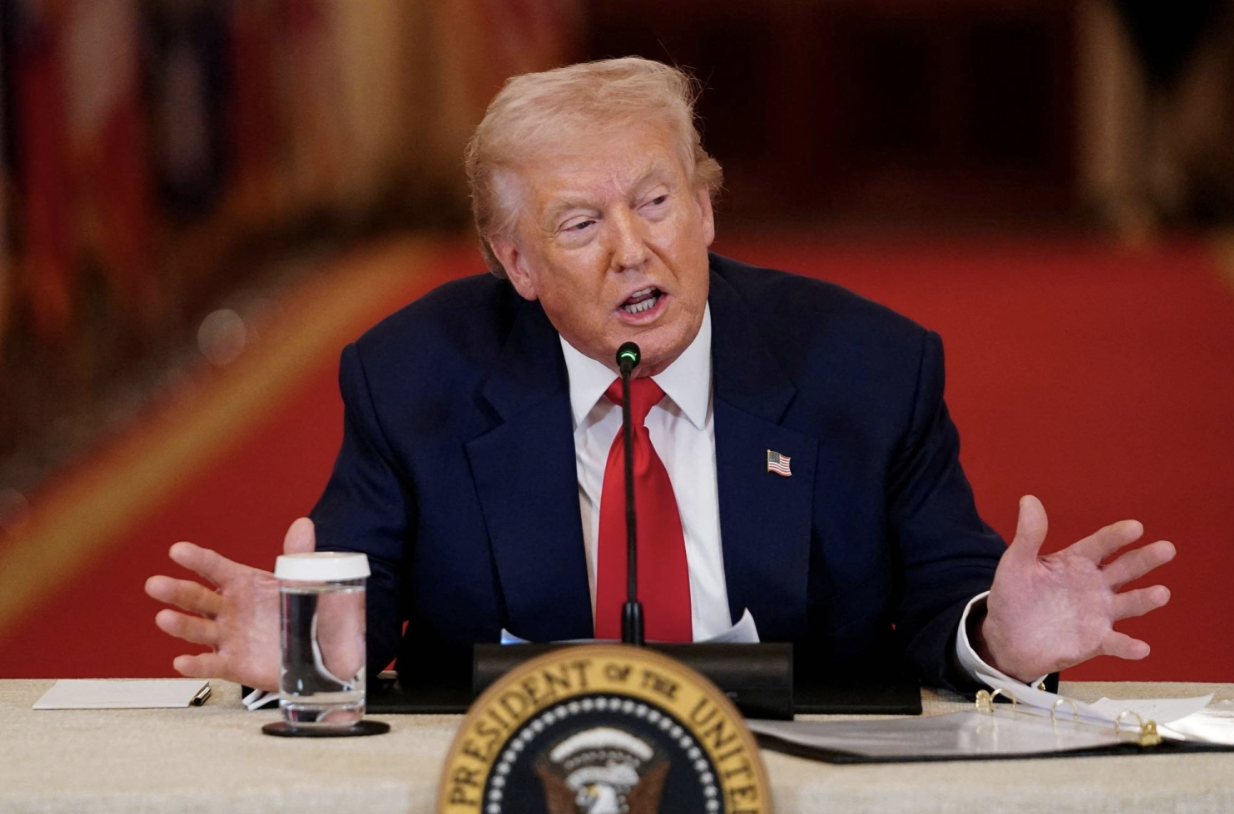
The sitting President of the United States, Donald J. Trump, once claimed that Chinese President Xi Jinping does not dare to provoke him, because Xi knows he is “crazy.” However, through analysis of political frameworks explored throughout The Dictator’s Handbook by Alastair Smith and Bruce Bueno de Mesquita, Trump’s actions should not be deemed crazy but are in fact very logical. As the tagline of the book states; “bad behavior is always good governance”.
The book presents an idea of selectorate theory; a theory of government that studies the interactive relationships between the sections of a population that hold different amounts of political power. From largest to smallest, the nominal selectorate, the real selectorate, and the winning coalition.
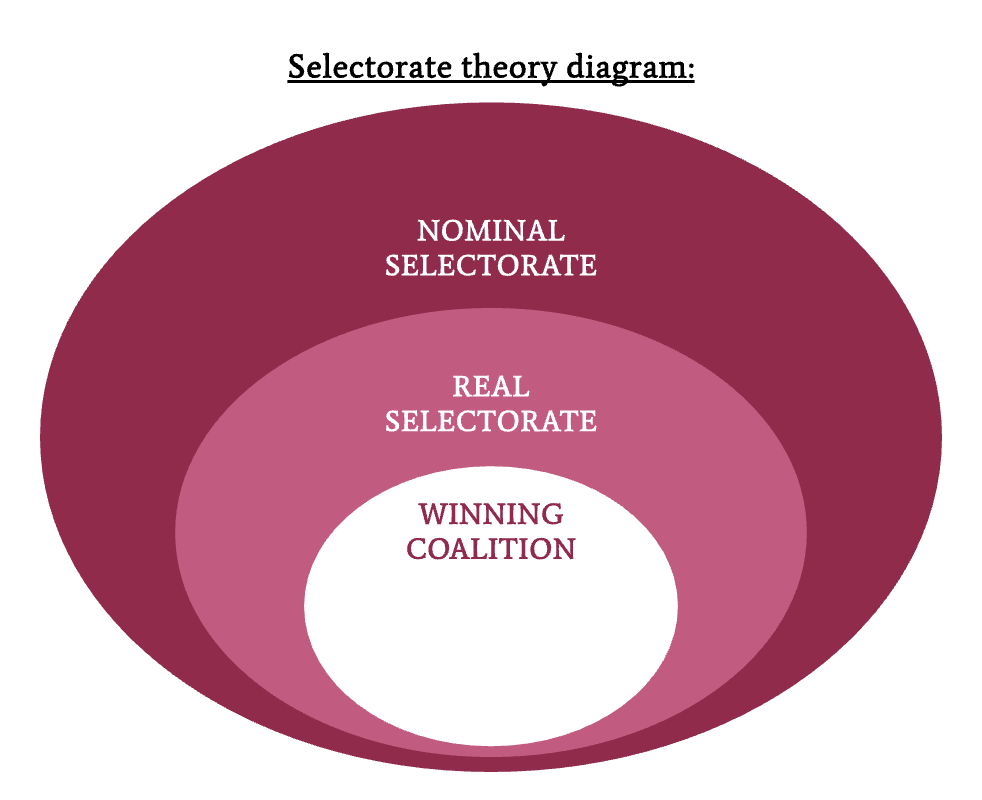
The first section; the nominal selectorate, including “every person who has at least some legal say in choosing their leader.” This section of the population is also termed ‘the interchangeables’, in this case referring to all eligible voters who merely have “a toe in the political door”, as if a few of them were lost or switched out, it would be inconsequential in the broader context.
The second; the real selectorate “includes those whose support is truly influential.” If a few of them were lost, depending on how influential, it could be costly, but would not eliminate the overall success of the autocrat. Therefore, they are also termed the influentials. In the US, this group includes people like the electors of the electoral college, voting blocks, which are large groups of people that vote strongly based on a specific common concern such as a religion, and financial contributors such as lobbyists and campaign financers.
The last group is termed the winning coalition; also known as the essentials, they are those whose support is necessary for the success of the leader. In the US, essentials include generals, appointed officials, courts and institutions that rule in favor or against the leader. Afterall, if the leader is not respected or followed, they will be leader in name only, holding no real power over the masses—trapped in a gilded cage of unimportance. This is partially what happened during Trump’s first term. As his son, Don Jr. told The Wall Street Journal before the elections, “we want people who are actually going to follow the president, the duly elected president, not act as sort of unelected officials that know better, because they don’t know better,” criticising his father’s first cabinet while hinting at a more loyal essentials in 2024.
Anyone outside of this political system is disenfranchised. In democracies, the disenfranchised are much smaller than autocracy as more people have direct political say in democracies than autocracies.
Variations in the size of interchangeable, influential, and essential groups provide a structured framework for analysing the complexities of political life and organisational dynamics. These differences across states, businesses, and other organisations alike determine the operations of political systems determine how much power the leaders hold; “what they can and can’t get away with, to whom they answer, and the relative qualities of life that everyone under them enjoys (or, too often, doesn’t enjoy)”.
Despite perceptions deeming Donald Trump as ‘crazy’, through the lens of selectorate theory there is some sense to his actions; observing this democratic backsliding of America through a more analytical versus ideological perspective.
The main assumption which the book makes is that politicians want "to come to power, to stay in power and, to the extent that they can, to keep control over money."
Adding onto this idea, the fundamental thesis of selectorate theory is that when the coalition is small, as in autocracies, the leader will tend to use private goods to satisfy the coalition, while the disenfranchised suffer. Think 18th century European monarchies, where the peasants starve while the royal family and their friends feast. When the coalition is large, as in democracies, the leader will tend to use public goods like building infrastructure or enacting programs like social security, and support popular wedge issues like immigration, to satisfy the coalition. Think how since all eligible voters in the US can prop up and take down leaders during elections, they must all be pleased. This cannot be done realistically by paying all of them individually as the population of eligible voters total over 200 million. This is simultaneously why the first rule to being a good dictator is to “keep your winning coalition as small as possible. A small coalition allows a leader to rely on very few people to stay in power. Fewer essentials equals more control and contributes to more discretion over expenditures.” Trump is clearly a transactional individual; perfect for the autocratic private returns dynamic. Namely, crypto ventures, foreign gifts and deals, selective pardons, etc.
Perfectly democratic coalitions have winning coalitions, influentials, and essentials of similar sizes, as all sectors should be equally important if operating under the assumption that everyone truly has political say. Thus, the US is not a direct democracy, rather a representative one, where the people vote for an elected representative to create laws and policies on the people's behalf.
Using this idea of coalition sizes, Trump’s actions are surprisingly logical and hint at an autocratic turn for American politics not only ideologically, but literally. Once the president is elected, the public’s power to remove them from office is limited. So when the president is in power, the winning coalition shrinks. Trump is trying to further shrink it.
Revisiting the DOGE cuts from Elon Musk’s days in the office, it was clearly a test of how much of the essentials and influentials they could cut, a blueprint for carrying out the administration’s vision to shrink the government. One of the major coalition reducing actions the administration took was taking control of the OPM, the Office of Personnel Management, and cutting at least 280,000 workers. When estimated in May, that amount made up around 12% of the civilian federal workforce. “OPM is looked at as a model. The goal is to reduce the footprint of the federal workforce,” Anthony Armstrong, a senior adviser at OPM and a banker who helped Musk acquire Twitter said.
Although the government shutdown has now ended, it was the longest in US history. This once again makes perfect sense in the context of the previous paragraph; "We'll be laying off a lot of people," Trump said on 30th September, the day before the shutdown began. In early October, the administration's attempt to lay off about 4,000 workers was temporarily blocked by a federal judge, but the White House has appealed against the ruling. Moreover, with the shutdown, the judiciary still operates, but is more limited, giving the executive branch more power, once again shrinking the number of essentials.
Furthermore, on January 24, 2025, U.S. President Donald Trump announced the firing of at least 17 inspectors general at federal government cabinet departments and agencies. Since then, he has fired many more. Most of these roles have been vacant since. The Office of the Inspector General is an independent, nonpartisan oversight division of a federal or state agency aimed at preventing inefficient or unlawful operations within their parent agency, and the erosion of corruption laws further decreases the winning coalition, as he lessens the amount of people holding the leader accountable. It furthermore allows the transactional, corrupt, private rewards of autocracy legal.
Nonetheless, a good leader must also maintain a large set of influentials so you can easily replace any troublemakers in your coalition. It puts the essentials on notice that they should be loyal and well behaved or else face being replaced—this is very apparent with how quickly he replaces people within the government due to a lack of loyalty.
Musk was a clear example; he was once the most infamous billionaire funding Trump’s campaign, but nowadays a multitude of corporations spend money on him, from Apple to Google. It was foreshadowed at his inauguration—the row of billionaires, from Mark Zuckerberg to Jeff Bezos. Musk wasn’t special. This incentivises them each to spend the most money, fighting for Trump’s loyalty. Look at the 200 million dollar ballroom being built right now; "I view this enormous ballroom as an ethics nightmare," Richard Painter, a former chief ethics lawyer in the Bush White House between 2005 and 2007, told the BBC. "It's using access to the White House to raise money. I don't like it," he added. "These corporations all want something from the government." A pledge form seen by CBS News, the BBC's US partner, suggested that donors could be eligible for "recognition" for their contributions.
Another instance is how he treats foreign nations. Regarding the Russia/Ukraine conflict, whenever he feels that Russian president Vladimir Putin is prolonging the war, he criticises him, such as sharing an editorial on Truth Social criticising the leader for “opposing Trump’s agenda.” Yet when he feels that Ukraine president Volodimir Zelenskyy is not giving enough concessions, he alienates them, such as proposing a 20-point plan to end the war awfully similar to the Russian demands. This creates tension in both relationships, maximising his own leverage, as both Russia and Ukraine are unsure how much they can demand until the POTUS turns towards the other side again.
To complete the optimal coalition sizes for autocracy—small group of essentials, large group of influentials, and finally—a smaller group of interchangeables. This is seen as he continues his conquest to gerrymander red states to win more seats in the next midterms. By doing so, he shrinks the power of opposition voters.
However, Trump’s strategic run may be coming to an end. As his age and health becomes an increasing focal point for the media, from his bruised (and badly covered up) hand to his claims of taking 325mg of aspirin daily instead of the recommended 81 to his neck rash, the MAGA coalition is simultaneously showing its splits. Even once loyalists are criticising his actions, with Marjorie Taylor Greene’s resigning due to her belief that Trump’s foreign policy was not “America First,” Nancy Mace signing the discharge petition to demand the release of the Epstein files from the Department of Justice despite Trump’s position, and Elon Musk leaving the Trump circle in an infamous breakup—though they have since reconciled, their bromance is nowhere near close. The selectorate theory explains this; “dead leaders cannot deliver rewards to their coalition. Dying leaders face almost as grave a problem. If essential backers know their leader is dying, then they also know that they need someone new to assure the flow of revenue into their pockets. That’s a good reason to keep terminal illnesses secret since a terminal ailment is bound to provoke an uprising, either within the ranks of the essential coalition or among outsiders who see an opportunity to step in and take control of the palace,” hence why Trump continually gaslights and covers up his health diseases. The White House doctor claims he is “in very good health,” despite his body saying otherwise.
Thus, whether the MAGA coalition can continue is up to the power of JD Vance to inherit Trump’s transactional persona. Vance himself has been positioning himself as a 2028 frontrunner, and has been struggling to navigate the perceived charisma gap between Trump and himself, acting as more of an extension, ‘loyal man’ of the president. Rather than trying to replicate the unique characteristics of the current President which keep the flame and cult-like behaviour of MAGA alive, he positions himself as more of a stabiliser to Trump’s erratic high energy behaviour.
Though the successes of this strategy are questionable, given Vance’s marriage with Usha Vance, an Indian immigrant, which may jeopardise his white nationalist agenda (though, this relationship may be coming to an end…watch out for future articles!). But perhaps more importantly, is the infighting within the current government. As Vance takes more solid stances on questions of antisemitism, the extent of immigration enforcement, and Epstein, the unstable, increasingly divisive nature of the cabinet will lead to both friends and foes by 2028…
