
The Sixth Stage of Grief: Capitalism
By Marina Yan
Edited By Lily Nie
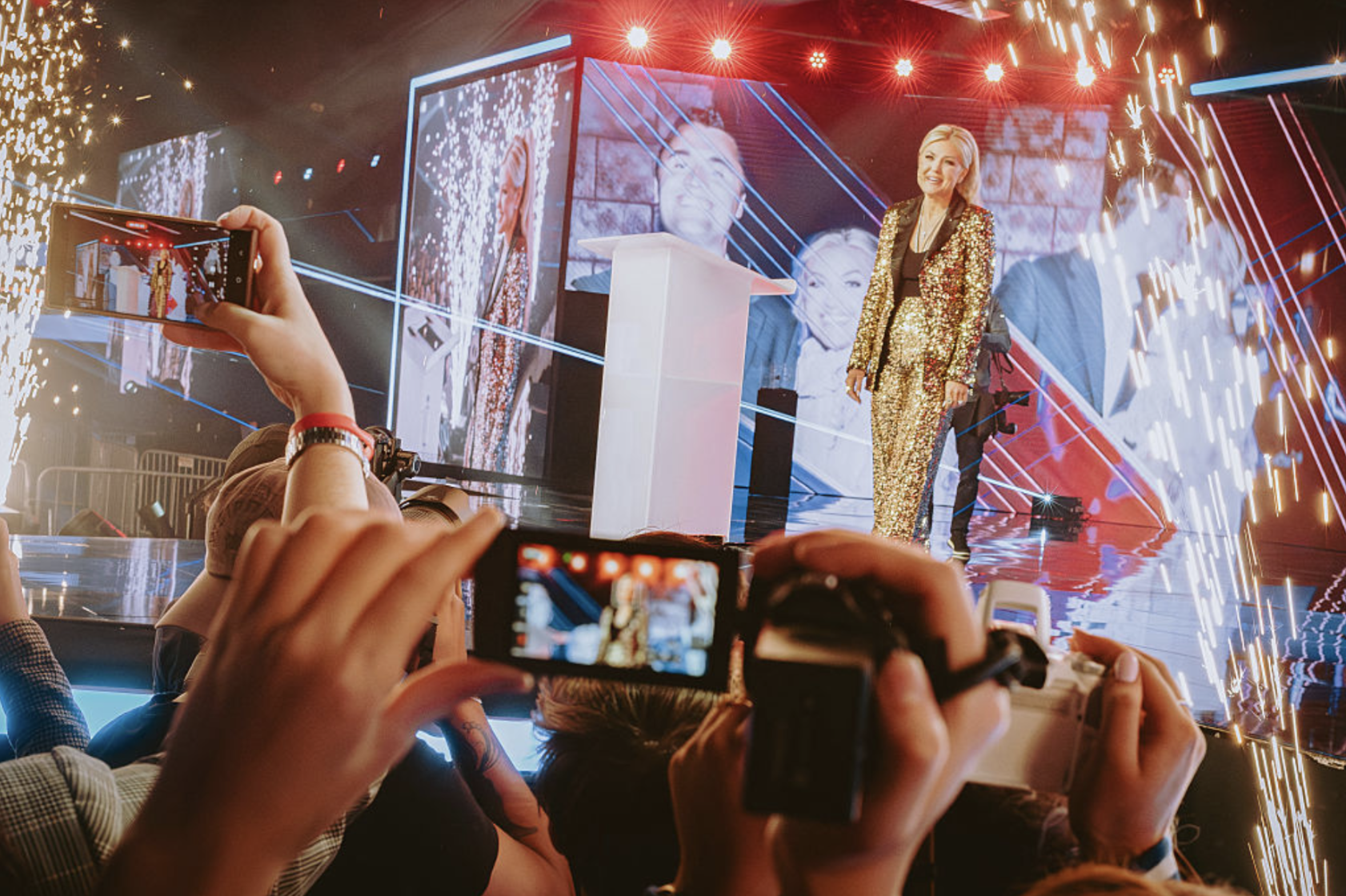
“The role of women is to be a wife and a mother, your heart has to be fully in the home,” said Erika Kirk, a woman who, despite having children and a late husband, has also built a successful career capitalising off those aforementioned aspects of her personal life — embarking on her newest venture; the grief tour. With claims of mourning the infamous death of her husband, Charlie James Kirk, Erika dances across the stage in her sparkly suits, throwing merchandise into the crowd, and even featuring famous rapper Nicki Minaj. This performance stands in stark contrast to more traditional expressions of grief, typically characterized by quiet reflection, solemn environments, and black attire.
While it is ostensibly arguable that Kirk simply did not care for her late husband, this spectacle underlines a deeper reality pertaining to the capitalisation of events in modern society, especially ones which are made to be dramatic and sensationalised. Kirk’s performance is not merely tasteless; it symbolizes a broader cultural condition in which authenticity and virtue become secondary to engagement, profit, and extravaganza.
One of the core tenants of neoliberalism is the erosion of bureaucracy combined with heightened individualism, diminishing the role of politics and collectivism in our everyday lives. This, combined with the reactionary postmodern movement’s rejection of grand narratives as opposed to the modernist search for truth, creates an emotional emptiness. Where values do not exist, people are driven only by capital; the ends of wealth justify the means.
In Capitalist Realism, Mark Fisher argues that capital “has resolved personal worth into exchange value,” turned “belief to aesthetics,” “engagement to spectatorship.” Capitalism is “what is left when beliefs have collapsed at the level of ritual or symbolic elaboration, and all that is left is the consumer-spectator, trudging through the ruins and the relics.” Through these quotes, Fisher elucidates that capitalism has hollowed out principle, meaning, and agency, replacing them with consumption, surface aesthetics, and passive spectatorship. Capitalism is not just an economic system, it has become a naturalized set of worldviews we adhere to. Thus, moments are no longer moments, rather business opportunities. Sadness can no longer exist as a private sombre moment, because silence is unprofitable; ergo the conversion into a moment of music and fireworks.
This void of apathy, perhaps even nihilism, that modern capitalism brings is accelerated through disassociation as a result of political orders associated with economics; ones which prioritize economic-related issues over political engagement, as Hannah Arendt described in her theories of totalitarianism. Arendt argues this leaves mere “economic men,” who are disconnected from the political realm, a realm where ideas are exchanged together in plurality, creating a shared world. The theory was derived through the observation that most Nazis were not clinical psychopaths, rather just regular people who were simply doing their jobs with no concrete moral grounds. Consider the ancient Greeks; individuals who often put virtue as an importance over wealth—“and the great blessing of riches…is, that he has had no occasion to deceive or to defraud others,” claimed Cephalus in Plato’s Republic. In their political order, economics was a means to a political end. Yet today, as led by enlightenment philosophy, which played a major role in capitalism’s development, it is the polar opposite. Consider John Locke, one of the pivotal enlightenment philosophers. In his worldview, political engagement is to achieve an economic end of “life, health, liberty, [and] possessions.” This eventually leads to a loss of solid ethics, a “backbone,” and capacity for meaningful political judgment in the modern man.
Furthermore, sociologist Hartmut Rosa presents an idea of social acceleration, where our everyday lives have sped up tenfold as a result of technological advancements; a notion intricately linked with capitalist striving for profit. Harkening back to postmodern ideas, “historical development is no longer understood as running toward a determinate goal, and its ending remains uncertain”. This leaves citizens of modernity in a fragile, ever-stressed state, a condition of permanent urgency without direction, therefore making capitalist efficiency a dominant organizing principle.
All of this examination leads to one thing; voids of purpose filled incompletely with a craving for wealth. Many often wonder why in life there always seems to be a missing piece, why there is often a lack of meaning; perhaps, this is the reason. When we combine all the points established above regarding modern capitalism’s tendency to destabilize principles, focusing only on economic success, Erika Kirk’s movement makes total sense.
This self-marginalisation for the gain of profits is typical of current culture. Kirk knows women can be more than the traditional stereotype. “Eerily reminiscent of Margaret Atwood’s, The Handmaid’s Tale, and the character of Serena Joy, Kirk’s promotion of a movement, which pushes female passivity, parallels Serena Joy’s promotion of a system, which inevitably silences her,” wrote Candance Whawell in Palatinate.
Yet provocativity thrives in the attentional economy when all moral ground has been disintegrated. Under capitalist media and its monetary incentive for clicks, the idea of free speech or action is blurred; is to be free to be able to speak and do without prosecution, or to be able to speak without external forces driving your speech? Because if it is the latter, with this monetary incentive comes great influence, promoting controversial language and sensational events. We are not individuals, as neoliberalism poses, rather we are collectives, influenced by unwritten rules, what Jacques Lacan would call “the Big Other;” the representation of a symbolic order of norms and society that structures our subjectivity, desires, and unconscious.
Thus, when all ideas of virtue and truth have been disintegrated, one must ask whether figures like Erika Kirk and the broader right wing online movement are expressing genuine ideological concern, or merely performing acts of extremity for attention and clicks; an exercise of controlled speech disguised as freedom. If these theories of modernity are indeed true, then the grief tour, the vertical videos, and the podcasts are not political expressions at all, but empty shells of capitalism masquerading as thought.
